


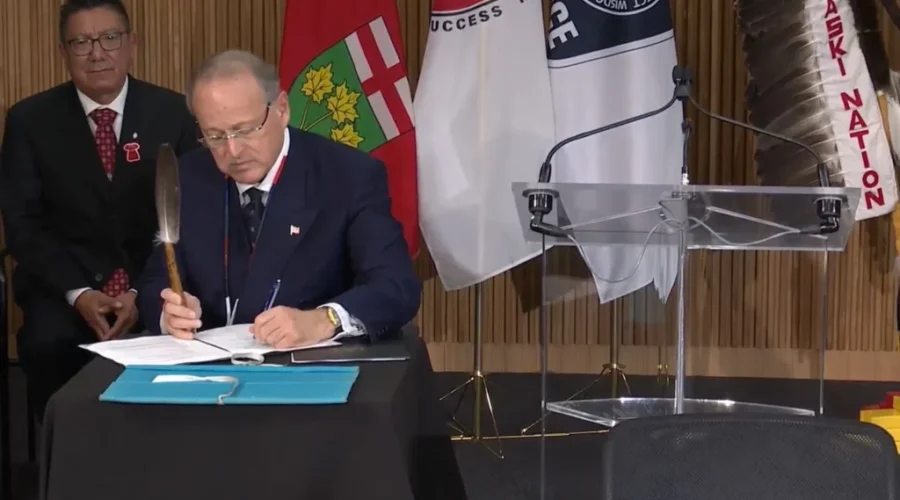
The Nishnawbe Aski Police Service Board (NAPSB) has become the first legislated Indigenous police service in the province.
The province has approved NAPSB opt-in to the provincial framework for policing called the Community Safety and Policing Act, 2019.
“When I started working with First Nations communities in August 1984, I was heartened by the warm welcome I received, but disappointed by the lack of resources for their safety,” said NAPS Chief of Police, Terry Armstrong. “Still, there remains much room for improvement. This new legislation represents a guarantee of safety backed by the rule of law, with more officers, better infrastructure, and better conditions all around. While we can’t turn back the past, we certainly can shape the future.”
During the signing ceremony, the province announced a $514 million investment to support NAPSB.
The funding will allow the Nishnawbe Aski Police Service to double the number of officers that serve 34 First Nation communities.
“Many people have worked for years to get where we are today. On behalf of Nishnawbe Aski Nation I acknowledge and thank them all,” said Grand Chief Alvin Fiddler. “It is vital that our dedicated officers have the support they need to serve our members in a safe and culturally appropriate way. Thanks to the CSPA, the First Nations policed by NAPS will now have access to the same standards and guaranteed funding that the rest of Canada takes for granted. This is what our leaders have asked for, and what our communities deserve.”
This signing allows the NAPSB to be legislatively recognized as responsible for delivering equitable policing to the communities it serves and have access to resources to do so.
“This landmark agreement is the first of its kind in Ontario. We could not have done it without the unwavering support of our Chiefs, past Board chairs, and Board members,” said NAPS Board Chair Frank McKay. “Our people deserve the same levels of safety and security as anywhere else in the province, and our dedicated officers deserve the appropriate supports so they can do their
important work safely and effectively. This landmark agreement will allow us to provide essential services to our communities in a culturally appropriate way that respects our people, our laws and
our ways of life.”
As part of the agreement, NAPS and its board will work towards increasing its officer complement to over 500 officers and meeting the requirements of the CSPA over the next several years.
“This is a historic day for policing in the province of Ontario,” said Solicitor General Michael Kerzner. “We’re proud to mark this momentous occasion alongside First Nations partners to help modernize and strengthen the Nishnawbe Aski Police Service to keep communities safe and protected.”
NAPS is currently funded through an over-30-year-old three-way deal with the provincial and federal governments.
According to the Nishnawbe Aski Nation, the current funding practice uses unfair terms and conditions to restrict the level of policing that NAPS offers to communities.
“Under the status quo, First Nations communities are not entitled to the same policing standards as non-Indigenous communities,” said NAPS in a release. “A First Nations constable is not a police officer. After (opting)-in under the CSPA, a police officer is a police officer, a police chief is a police chief, the same as anywhere in Ontario and Canada.”
NAPS is the largest Indigenous police service in Canada which serves 34 First Nation communities in the NAN Territory including 25 remote communities.
It currently employs over 260 uniform officers.
NAN is a political territorial organization representing 49 First Nation communities within northern Ontario and is spread across an area that equals two-thirds of the province from the Manitoba border up the James Bay Coast over to the Quebec border.