



Maybe you’ve had that moment in the toy aisle where you have to do a full double‑take at the price tag – a $600 toy?
Not a casual glance. A lean in. A squint. The kind of look that says, “That… can’t be right. Did they misplace a decimal?”
You remember the days when a big box of LEGO was the cheap Christmas gift? The one that didn’t require a family discussion and maybe a little guilt. Those days are long gone.
They’ve vanished somewhere between rising grocery bills and the moment LEGO quietly decided it was no longer a toy company, but a luxury brand.
Because you can be minding your own business when suddenly—bam—there it is. Your kid wants a LEGO set with a $600 price tag.
Six. Hundred. Dollars.
At that point you’re not shopping anymore. You’re teaching your kid the basics of how money works.
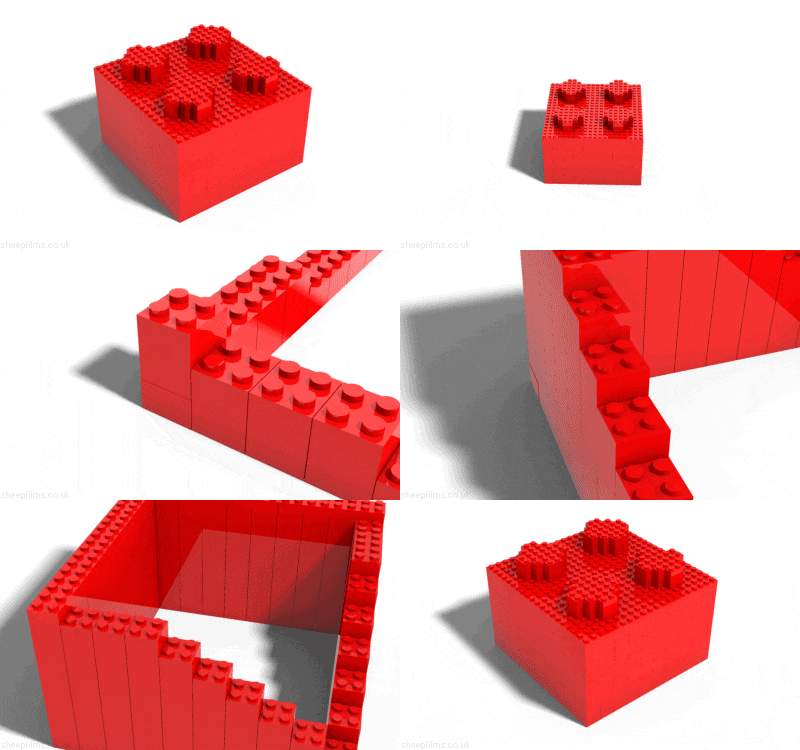
$600 Lego, a new gold standard?
There’s something oddly fascinating about how expensive toys have become. At what point did plastic building bricks enter their “investment era”? When did we stop saying “Wow, that’s cool” and start seeing a $600 toy as just another fact of life?
Maybe you’ve already start doing the mental math. A $600 toy. That’s groceries for weeks. Or one week, depending on the size of your family.
A $600 toy is like two brand new winter tires. Or that unexpected bill you pretend doesn’t exist.
And sure, LEGO is creative. It’s educational. It encourages problem‑solving, patience, imagination… and the ability to withstand stepping on sharp objects barefoot. It’s one of the few toys that can still hold a kid’s attention for hours.
But still. A $600 toy doesn’t feel like a toy anymore. It feels like something you insure.
The universal parent response
Most parents, when faced with a $600 toy request, don’t hesitate.
The answer comes out fast and confident:
“No.”
This doesn’t make you mean. This makes you the responsible kind if parent. The kind that says, “I love you, but also I enjoy having heat and electricity.”
Usually, that’s the end of it. The request gets redirected to birthday lists, holiday wish lists, or the mysterious category known as “we’ll see.”
Because in most households, a $600 toy with that kind of price tag isn’t a part of an ongoing negotiation tactic. It’s a full stop.
But there’s always that one kid…
Every once in a while, though, a kid looks at a price like that and doesn’t see a wall.
They see a challenge.
Instead of waiting for a birthday, or hoping Grandma suddenly feels generous, they start asking a different question:
“Okay… so how do I actually make that kind of money?”
And that’s where this story takes a turn.
Because there is a 12‑year‑old kid in Southern Ontario who saw a $600 LEGO set and didn’t argue, negotiate, or give up.
He made a plan.
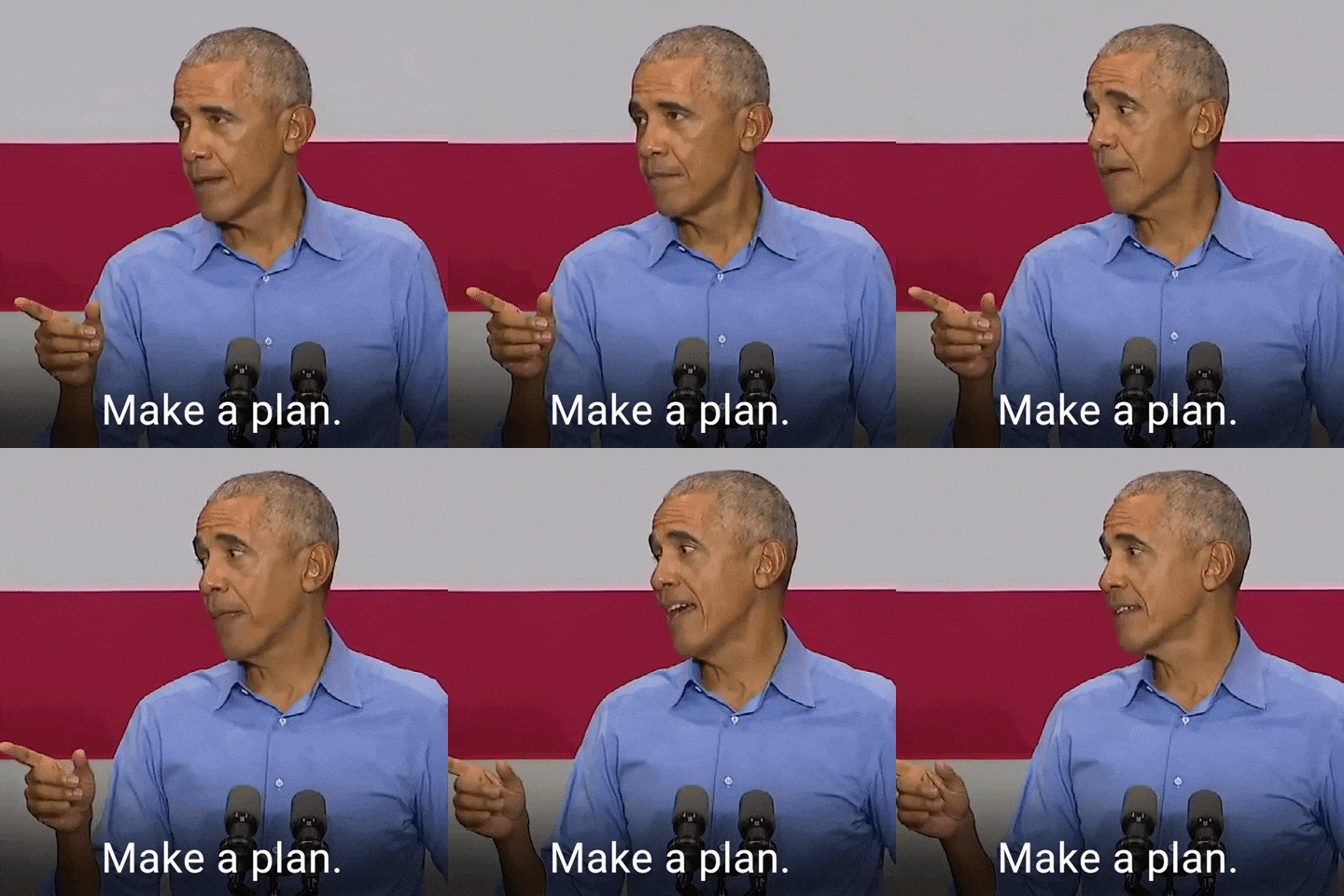
Wanting versus doing
This is the part that makes the story so compelling. Not the $600 toy itself, but the gap between wanting something and figuring out how to get it.
Most of us, adults included, are very good at the first part. Wanting is easy. It’s the second part that usually stops us. The effort. The planning. The follow‑through.
Somewhere along the line, we learn that it’s easier to lower expectations than raise our work ethic.
But this kid didn’t.
Instead of asking someone else to solve the problem, he decided to take it on himself. And not in a small, symbolic way. He did it in a way that required time, consistency, and actual responsibility.
Which, let’s be honest, is not what most people expect from a 12‑year‑old.
What makes this kid different
What makes this story stick isn’t just that a kid wanted something expensive.
It’s that he treated it seriously.
He didn’t see the number and laugh it off. He didn’t assume it was impossible. He didn’t wait for someone else to step in.
He saw a goal. He figured out a path. And he followed it.
That’s the part that makes you stop scrolling. Because it raises a bigger question. Not about toys, but about effort, motivation, and what happens when kids surprise us.
What this kid did to earn that $600 toy is the entire reason this story is worth hearing. It’s unexpected, it’s impressive, and it’s a reminder that sometimes the most interesting ideas come from the simplest question:
“What if I actually tried?”
So rather than spoil it here…
🎧 Listen to my audio clip below to hear how a 12‑year‑old turned a $600 LEGO dream into a real‑world plan.