

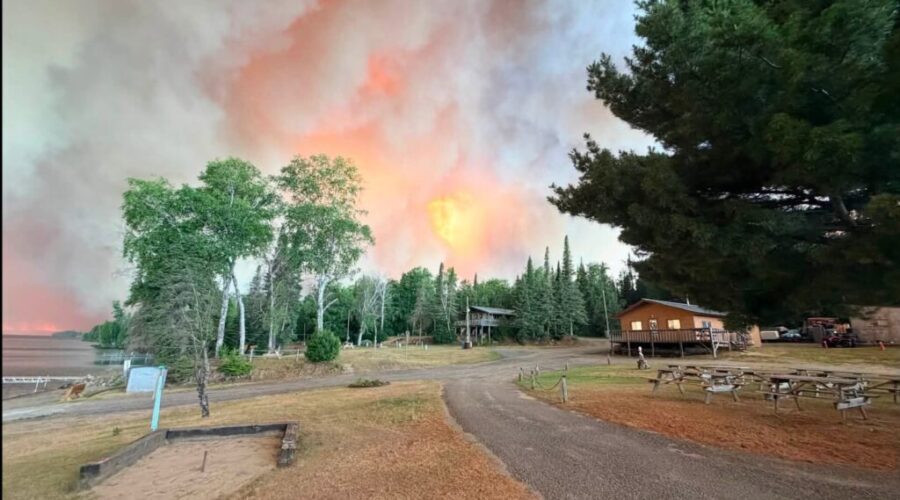
Rylie Isaacs and Rob LaForge, who together own Lac Des Mille Lodge, first noticed wildland fire smoke on June 30.
The resort-owning couple reported the smoke plume to whoever would listen, and did their best to keep an eye on the distant fire over the coming days.
They watched as the fire slowly diminished, before suddenly exploding in size and ferocity two weeks later on July 13, as a heat wave gripped the region.
“We were very concerned that the situation had changed and it seemed like there was a fire close by,” says Isaacs. “We contacted the MNR (Ministry of Natural Resources) to report that there was smoke coming onto the property, that our customer had burning birch bark falling into their hair out on the lake.”
LaForge says guests at their resort, which is located on Lac Des Mille Lacs, were beginning to become concerned, and he began contacting the MNR.
He says a representative from the Thunder Bay Fire Management Office “assured me that we weren’t in any danger. He explained that the fire had moved approximately five kilometers that day, but we weren’t in any kind of imminent danger.”
LaForge disagreed, but the MNR representative only conceded that guests could be told to seek shelter in Thunder Bay “if they wanted to,” and that no evacuation notice would be issued.

By the afternoon on that day, LaForge says guests were beginning to leave, while he and Isaacs began preparing for the worst.
They began packing up what he could, and that evening, LaForge reached out to the MNR a second time, reaching the same supervisor he’d spoken to before.
“There was fire right at our doorstep, all over the islands in front of the resort, about 400 yards from us. I could see flames at this point, which I was explaining to this gentleman I was speaking to from the MNR,” LaForge recounts. “That’s when he explained to me that what I was seeing was spot fires. And he then said, ‘consider yourself evacuated,’ which we were already leaving.”
Calling for answers
Isaacs and LaForge say they have received a lot of scrutiny online from figures asking why they weren’t better prepared to run away.
“People are saying, ‘when you saw the smoke, why didn’t you evacuate?” says LaForge. “Listen, this is nine years we’ve owned this resort, and we’ve had smoke roll into our resort many, many times in the past. If we were to evacuate every time we had signs of smoke, I mean, we had signs of smoke in Thunder Bay. We didn’t evacuate Thunder Bay. Why would we evacuate our business? This is our livelihood.”
On her phone, Isaacs shows this reporter screenshots of NASA heat maps in the days leading up to their eventual evacuation, showing how the fire subsided, and then grew rapidly.
“We were told that the fire was a ways away, that were were just seeing smoke from the fire. We followed the fire map, and it showed that there were days when there was no more fire even registering… So when on July 13, when that smoke flooded into our property, we were caught completely off guard that there was a giant fire barreling towards us,” Isaacs explains.
Isaacs and LaForge have connected strongly with the latest news from several First Nations communities that made the difficult decision to evacuate with little or no guidance from the MNR, and are now demanding answers from the provincial government.
“Then I learned about the fires in Armstrong, Collins, Whitesand First Nation, and after listening to their news conference, it was echoing our story,” says Isaacs. “How they weren’t alerted and made aware, so that they had time to evacuate.”
Isaacs and LaForge are now joining their voices with the involved First Nations, and agree that a public inquiry is needed.
“We stand with Lawrence Wanakamik, Chief of Whitesand First Nation, and the 10 other First Nation leaders as they call for an independent public inquiry into the operational dysfunction in evacuating their communities,” Isaacs says. “We stand with them because we too want to know why the evacuation was first denied to us, and then didn’t happen in time.”
Isaacs has been gripped by some of the stories that have emerged of harrowing escapes, such as that of the Collins First Nation.
“People are traumatized, and we have to live with that, knowing that information didn’t get out there, that they weren’t warned… and I’ll tell you, it was the scariest thing we’ve ever seen.”
LaForge says his concern going forward is about evacuation orders going out too late.
“This could have been avoided… You can’t just say that things got out of hand at some point,” he says. “And we made it clear by calling in advance and letting the authorities know that it was far worse than they were saying it was, because we were there. We were on the ground and we could see. And that’s what is upsetting here is that nobody took us seriously, and nobody did something, nobody came out to see what we were seeing.”
“And we were really disappointed to see Doug Ford come to town, and them patting each other on the back, saying they did all they could to keep us safe and protected because they didn’t,” adds Isaacs.