


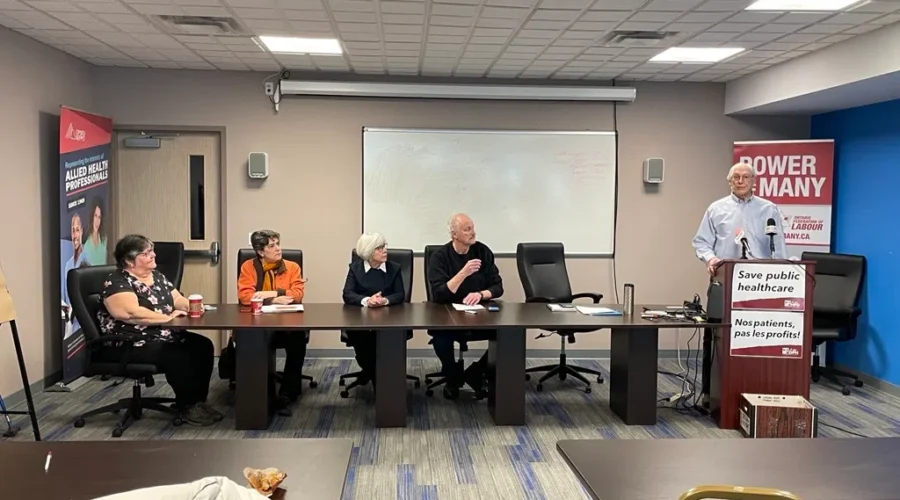
A group in the region that supports injured workers is advocating to see worker’s compensation and support reform in the province.
The Thunder Bay and District Injured Workers Support Group (TBDIWSG), in partnership with the Ontario Network of Injured Workers Groups, has created a new act to replace the Workplace Safety and Insurance Act.
They are calling it the Meredith Act in honor of Sir William Meredith the architect of the original compensation system in the province.
A year of consultations and revisions along with legal assistance was needed to get the group’s goals formatted effectively to be brought to the legislature.
“It is time to put the focus on injured workers and injured workers are saying we’ve had enough,” said the President of the Ontario Network of Injured Workers Groups, Janet Paterson. “Something has got to change and Meredith’s Act is step one in bringing an emphasis because really it’s an emphasis that should be on every single worker and it should be on every single family member.”
The goals of the act are to ensure that workers and families are properly provided compensation when they are injured, made sick, or get killed on the job.
They also hope to see information gathered, analyzed, and distributed on workplace injuries so recommendations can be made for potential investigations change or prosecution.
Ultimately the hope is to see the fair treatment of injured workers.
“The poverty rate is between 45 and 50% for permanently impaired injured workers,” said Paterson. “Poverty rate, you get hurt, you don’t get entitlement, but you’re stuck with this whatever the impairment is, you worked for a long time, you had a good job, you had a life you had things of value in your life.”
According to the TBDIWSG, in 1915 workers and their families in Ontario lost the right to seek justice in court for workplace injuries or death.
At the time the trade-off was done by Sir William Meredith in exchange for injured workers receiving no-fault and timely compensation through an independent system.
The organization says over the last 30 years the trade has been killed off.
Now workers have no legal right to seek compensation through the court, and they must rely on the Workplace Safety and Insurance Board.
If a claim through the WSIB is declined there is no resources for an injured worker outside of employment insurance and other forms of community assistance.
“I always said to my kids, life was always 101 ways to tell your kids no,” said Paterson. “Because they still went to school, they were in their younger years, they didn’t understand that there was no money and those things they really harm workers and they harm families and you don’t see it until you live it.”
The impact of a workplace injury goes beyond the physical injury and the financial loss.
“So there’s the poverty of it, but there’s the mental health because when you’re working, you don’t realize all those other things that you get from work. You go to work, you get to see your friends, you feel like you’re doing something, and you have value, I have value.”
“I am needed and all of a sudden you get injured if you’re fortunate enough to have an injury that you recover that’s what you do, but if you’re not fortunate enough, then it spirals, because now all of a sudden your workplace doesn’t look at you,” said Paterson. “I used to tell my employer, I can’t possibly be this good like you embarrass me, and I was that good until the day I became permanently injured and all of a sudden you are nothing to them.”
This comes as the provincial government and the WSIB announced they were returning $2.5 billion in surplus funds to the economy by delivering the funds to businesses.
Despite the declaration of having more money than needed, injured workers are still going without the support they require.
“You have the WSIB announcing that, you know what we are going to give back $2.5 billion to our employers this year,” said Paterson “$2.5 billion, has anything changed for these injured workers Are we doing any better? Are we getting the treatments? The help that we need? It’s a slap in the face that they’re thinking that this is what they should be doing with this money, it’s criminal.”
“They should not be allowed to return money to the employers until every single worker who is on the books until they have gone through the appeal system. Today is a day to celebrate because we’re saying enough is enough.”
The provincial NDP brought the act to the fall session of the Ontario legislature but the election call has stopped any progress.
Following the election the NDP plans to bring the act back to the legislature if elected.
If they are not the injured worker support groups are putting it forward as a private members bill.