

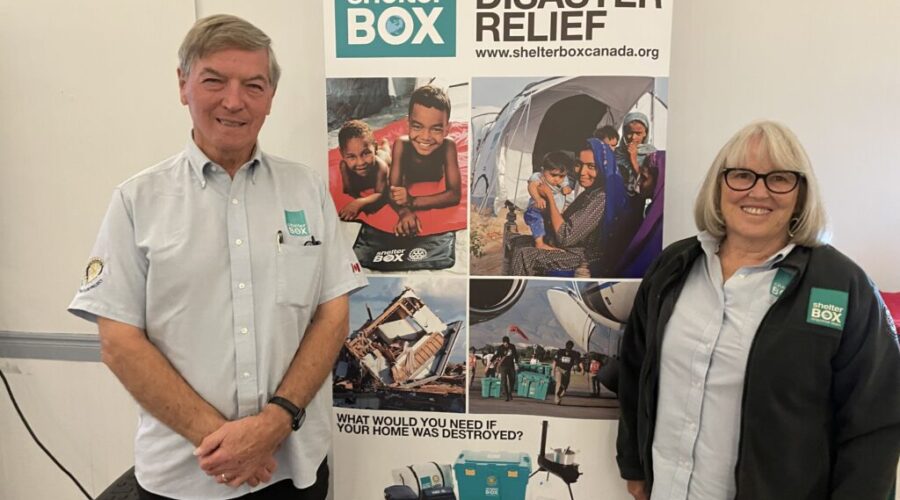
When most people in Kenora think of retirement, the mind drifts to boats on Lake of the Woods, slower mornings, and perhaps finally getting around to that long-neglected garden project. For Ron and Claire Noseworthy, retirement looked a little different.
Instead of slowing down, they geared up. Instead of seeking comfort, they sought out chaos.
Ron and Claire are the definition of Hometown Heroes, but their heroism often takes place thousands of kilometres away from the Lake of the Woods. As dedicated volunteers for ShelterBox, this Kenora couple has spent years deploying to some of the most devastated regions on the planet. Places levelled by earthquakes, typhoons, and tsunamis.
While their passports are stamped with the evidence of their global service, their hearts remain firmly rooted in Northwestern Ontario. Their story isn’t just about disaster relief, but about how two people from our community decided that having “time on their hands” was actually an invitation to change the world.
The spark of service
For Ron and Claire Noseworthy, the journey began simply. “We were both recently retired,” Claire recalls. “And so we kind of had time on our hands and we went to this display and we thought, ooh, now this is interesting.”
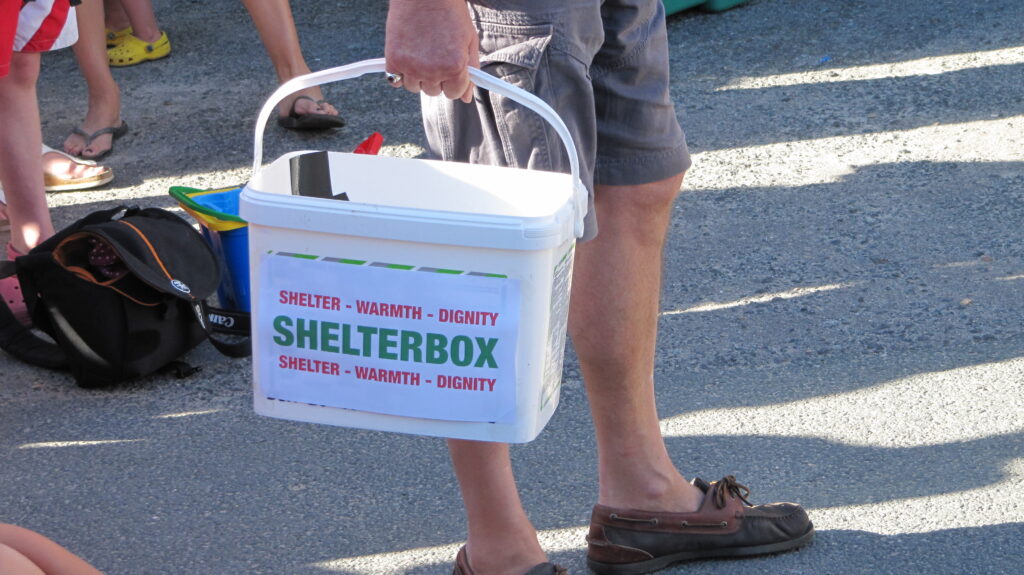
That display was for ShelterBox, an international disaster relief charity that provides emergency shelter and other essential items to families who have lost everything. But for Ron, the motivation went deeper than just filling free time.
“I developed what I would call a social conscience when I was in university,” Ron explains. “I felt I had a pretty good life and I saw the great need in the world for a variety of things and I wanted to give back and I had trouble figuring it out, just what it would be.”
When ShelterBox appeared on their radar, it clicked. It was the perfect vehicle for their desire to serve. The organization, although separate from the Rotary Club, was started by a Rotarian in England in 2000 who wanted to create an immediate response to disasters.
Crucially, the philosophy wasn’t just about dropping supplies. It was about dignity. The founder had witnessed disasters where aid was simply “flung out into the crowds,” a process he viewed as humiliating. He wanted a more humane manner of distribution, ensuring that aid came with respect.
This philosophy resonated deeply with the Noseworthys. As Ron puts it, the goal is providing “a hand up rather than a handout.”
Not for the faint of heart
It’s one thing to donate money to a cause. It’s entirely another to fly into a zone where infrastructure has collapsed. Becoming a ShelterBox Response Team member requires a level of grit that Ron and Claire possess in spades.
“Not for the faint of heart,” Claire laughs when recalling the process.
The training is grueling. After qualifying in Florida—where they lived in tents and hiked through the Everglades in the middle of the night—they were sent to England for ten days of intensive preparation . Out of 16 applicants in their initial group, only five qualified for the final stage.
The work itself is physically and emotionally demanding. Deployments typically last two weeks, with team members working 10 to 12-hour days in difficult conditions.
“There’s risk involved as well,” Ron admits. He recalls a deployment to Van in eastern Turkey following a massive earthquake. While staying in a hotel—chosen specifically because it was built to earthquake standards—a powerful aftershock hit.
“The chandeliers were coming down, the walls were shaking, we were all running to get out of the hotel,” Ron says. He later discovered that in the city of Van, other buildings had collapsed, and people had been killed in the hotel where relief teams had previously been staying.
Despite the dangers, including deployments to conflict zones and areas prone to radiation like Fukushima, Japan, Ron and Claire never shied away.
A hand up, a hug, and a colouring book
The technical aspects of their work—logistics, tents, tools—are vital. But when you speak to Ron and Claire, it’s the human moments that clearly fuel their fire. It’s the connection with individuals that transforms a “deployment” into a life-changing memory.
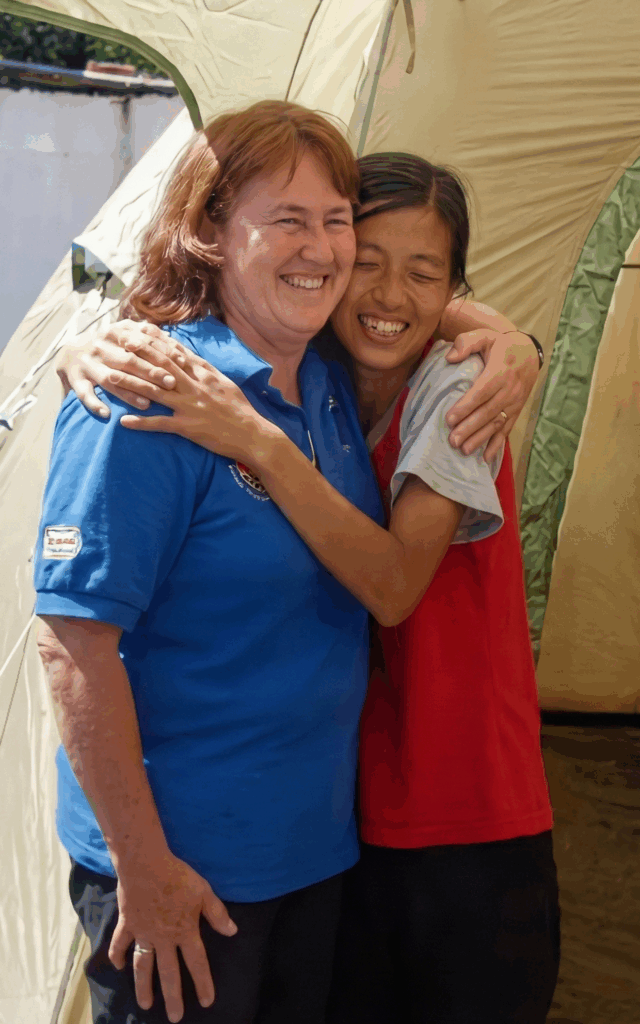
Claire shares a touching story from their very first deployment to China in 2008, following a catastrophic earthquake . They had distributed 500 tents and returned to an area to check on the families. Walking down the street, a woman approached Claire.
“This woman came up to me and you can see she absolutely, totally embraced me,” Claire says. “She recognized my emblem on my shirt… and connected it with her tent.”
The woman wouldn’t let go. “We were doing this kind of dance all the way down the street,” Claire remembers. “And it was so sweet.”
It turned out that the woman’s 12-year-old son had attended the Noseworthys’ demonstration on how to set up the tent. She was incredibly proud of how well her son had listened and built their temporary home.
“There isn’t money that could… change just seeing the difference we made in people’s lives,” Claire reflects. “That woman’s hug… that’s thanks enough.”
Sometimes, the impact is found in the smallest of things. During a trip to the Philippines, Claire witnessed a young boy holding onto a simple item from a ShelterBox children’s pack.
“I saw this little boy and he had this one little… colouring book which would have been, you know, three by five,” Claire says. “And he just was clutching it like it was everything. I mean, it was like a million dollars to him.”
In a world where he had lost his home, that small book offered a sense of normalcy and dignity. “I thought, we’re doing something right,” she adds.
Evolving with the needs
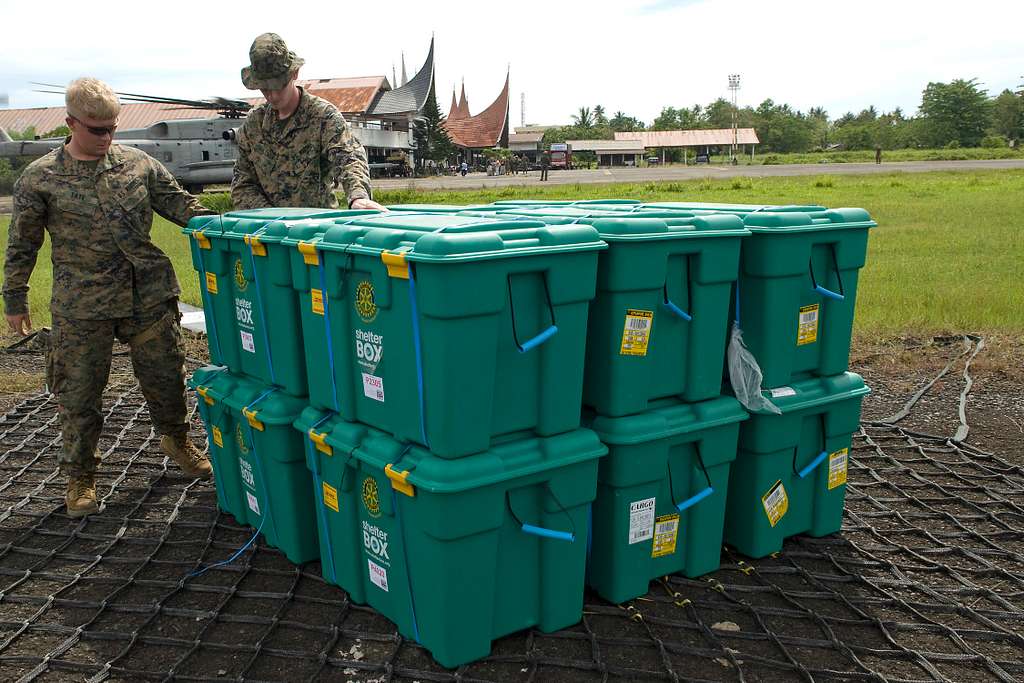
Over their years of service, Ron and Claire have watched the world of aid evolve. While the iconic green ShelterBox tents are still a staple, the approach has shifted toward sustainability and local empowerment.
“There’s been an evolution in ShelterBox, like a lot of organizations… it was just tents originally,” Ron notes.
Now, the focus is often on “shelter kits”—tarps, tools, and hardware that allow families to repair their own structures or build new ones using local materials. This shift isn’t just about saving money, it’s about resilience.
“I felt that the recovery was faster than getting a tent because they would build their own structure,” Claire observes. By using kits, families could build what was culturally appropriate for them, rather than living in a tent that looked the same as everyone else’s.
“We educate them as to how to build back better,” Claire says, explaining how they teach bracing techniques to withstand future high winds and heavy rains.
It’s a smart, adaptive approach to charity. It stimulates the local economy because supplies are often purchased within the country, and it treats the recipients as active participants in their own recovery, not just passive victims.
The view from Kenora
Ron and Claire Noseworthy have seen the worst that nature can throw at humanity. They have walked through rubble in Turkey, navigated floodwaters in Asia, and witnessed the poverty of Haiti.
Yet, these experiences haven’t hardened them. If anything, it has made them softer, more grateful, and more appreciative of the life we often take for granted here in Kenora.
“We take so much for granted here, clean air, clean water, and it really opened our eyes,” Claire says. “It really made us very thankful that we live where we do and we know that we’re really blessed.”
Ron echoes this sentiment. “You come back and you realize how incredibly fortunate we are. To be Canadians and then you add to it… we love Lake of the Woods, living in this area. We just realize how incredibly blessed we are.”
This gratitude is what drives them to continue advocating for ShelterBox, even when they aren’t on the ground. They now serve as ambassadors, helping to raise the funds that make these deployments possible. As Ron points out, the need is never-ending. “We never have enough. We never do… the need is greater than ever.”
A Legacy of “We”
In our previous profile on Lloyd Mack, we talked about the power of “we” over “I.” Ron and Claire embody this same spirit. Whether they were deploying as a married couple or, in later years, independently due to policy changes, they have always viewed their work as a partnership—with each other, with Rotary, and with the global community.
They are Kenora’s Hometown Heroes not because they sought the spotlight, but because they stepped out of the comfort of retirement to bring light to the darkest places on earth.
“It’s a hand up rather than a handout,” Ron reminds us. And for the Noseworthys, that hand is always extended.
How You Can Help: Ron and Claire emphasize that they can’t help unless they have the funds. “So we all do our part, and any little part that we do is important,” Claire says. To support the work Ron and Claire are so passionate about, you can donate at ShelterBoxCanada.org.